
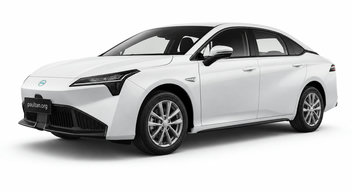

Verdict
The Aion ES is the longer-wheelbase electric choice, with a 55.2 kWh battery, 442 km claimed range and 136 hp/225 Nm motor. Its RM106,800 price is RM47,000 above the Proton S70’s RM59,800, though annual road tax is RM20 lower at RM70. The S70 answers with a 500-litre boot, against 450 litres, and six airbags plus blind-spot monitoring. For a buyer with dependable charging, the Aion’s eight-year/160,000 km warranty and EV running format justify scrutiny; for outright purchase cost and luggage space, the Proton is far easier to defend.
The ES EV (RM106,800) sits above every S70 variant here, so the verdict compares the closest-priced pairing — use the selectors above to match any two trims.
Pick the Aion ES if you can charge regularly and want 442 km EV range, a 2,750 mm wheelbase and an eight-year/160,000 km warranty.
Pick the Proton S70 if RM59,800, a 500-litre boot and its six-airbag safety package matter more than electric driving.
Key differences
- Price: Aion ES RM106,800; Proton S70 RM59,800.
- Powertrain: Aion ES has a 136 hp/225 Nm electric motor; Proton S70 has a 118 hp/150 Nm 1.5-litre petrol engine.
- Driving range/fuel storage: Aion ES claims 442 km from a 55.2 kWh battery; Proton S70 has a 50-litre petrol tank.
- Size: Aion ES is 4,810 mm long with a 2,750 mm wheelbase; Proton S70 is 4,602 mm long with a 2,627 mm wheelbase.
- Boot space: Aion ES 450 litres; Proton S70 500 litres.
- Warranty: Aion ES eight years/160,000 km; Proton S70 five years/unlimited mileage.
ES
- 442 km claimed EV range from a 55.2 kWh battery
- 136 hp and 225 Nm electric motor
- Longer eight-year/160,000 km warranty
- RM47,000 dearer to buy
- 450-litre boot is 50 litres smaller
S70
- RM59,800 entry price
- 500-litre boot
- Six airbags, blind-spot monitoring and rear cross-traffic alert
- Petrol power instead of the Aion’s electric motor
- Shorter five-year warranty
- Shorter 2,627 mm wheelbase and smaller exterior footprint
What the S70 has over the ES
Based on the published spec sheets of the selected variants — a blank field on one side can also mean unlisted data.
The ES's wheelbase is 123 mm longer, which usually translates to more rear legroom. The ES is 71 mm wider — more shoulder room, but a tighter fit in parking bays. Boot space favours the S70: 500 litres against 450.
Representative body-type outlines, drawn to scale from each car's length and height.
| Price & overview | ||
|---|---|---|
| Price | RM106,800 | RM59,800✓ |
| Body type | Sedan | Sedan |
| Segment | C-Segment | C-Segment |
| Assembly | CBU | CKD |
| Ownership | ||
| Road tax / year | RM70✓ | RM90 |
| Monthly instalment (est.) | RM1,090/mo | RM610/mo✓ |
| Insurance / year (est.) | RM3,025 | RM1,834✓ |
| Fuel or electricity / year (est.) | RM1,110 | — |
| Energy cost / 100 km (est.) | RM5.55 | — |
| 5-year running costs (est.) | RM21,022 | — |
| Charging (estimated) | ||
| AC charge 0–100% (est.) | 8.4 hours | — |
| DC charge 10–80% (est.) | 65 min | — |
| Powertrain | ||
| Engine Tech | 400V architecture | 16-valve DOHC DVVT (i-GT), Port Fuel Injection |
| Capacity | — | 1,499 cc |
| Horsepower | — | 118 hp at 6,100 rpm |
| Torque | — | 150 Nm at 4,000 rpm |
| Cylinder Arrangement | — | Inline 4 |
| Fuel | Electric | Petrol |
| Bore × Stroke | — | 73.4 mm × 88.57 mm |
| Number of Motors | 1 | — |
| Motor Horsepower | 136 hp | — |
| Motor Torque | 225 Nm | — |
| Battery Capacity | 55.2 kWh | — |
| EV Range | 442 km | — |
| Charging Rate (AC) | 6.6 kW | — |
| Charging Rate (DC) | 60 kW | — |
| V2L | 3.3 kW | — |
| Drivetrain | ||
| Transmission | Single Ratio Automatic | CVT Automatic |
| Transmission Name | — | 8-speed CVT with Manual Mode |
| Driveline | Front Wheel Drive | Front Wheel Drive |
| Performance & Efficiency | ||
| Top Speed | — | 186 km/h |
| Dimensions | ||
| Length | 4,810 mm | 4,602 mm |
| Width | 1,880 mm | 1,809 mm |
| Height | 1,545 mm | 1,466 mm |
| Wheelbase | 2,750 mm | 2,627 mm |
| Weight | — | 1,269 kg |
| Fuel Tank | — | 50 litres |
| Doors | 4 | 4 |
| Seats | 5 | 5 |
| Boot Space | 450 litres | 500 litres✓ |
| Front Tyre | 215/55 R17 | 205/55R16 |
| Rear Tyre | 215/55 R17 | 205/55R16 |
| Spare Tyre | — | Space Saver |
| Wiper Blade (Driver) | — | 24 inch |
| Wiper Blade (Passenger) | — | 17 inch |
| Chassis | ||
| Assembly | China (CBU) | Malaysia (CKD) |
| Front Suspension | — | MacPherson Strut |
| Rear Suspension | — | Torsion Beam |
| Front Wheels | 17 | 16" Turbine-style Alloys |
| Rear Wheels | 17 | 16" Turbine-style Alloys |
| Steering | — | Electric Power Steering |
| Safety | ||
| Airbags | — | 6 (Dual Front, Side and Curtain Airbags) |
| ABS/EBD | — | ✓ |
| Stability Control | — | ✓ |
| Alarm | — | ✓ |
| Immobilizer | — | ✓ |
| Child Safety Lock | — | Manual for Rear Doors |
| Blind Spot Info System | — | ✓ |
| ISOFIX | — | ISOFIX with Top Tether |
| Lane-keeping Assist | — | No |
| Seatbelt Reminder | — | Rear Seat Reminder, All Seats |
| Safety Notes | — | Blind Spot Detection, Lane Change Assist, Rear Cross Traffic Alert, Rear Collision Warning, Door Opening Warning; no AEB/ACC/lane-keep (camera ADAS reserved for 1.5TD Flagship variants) |
| Lighting | ||
| Headlamps | — | Halogen |
| Taillamps | — | LED Combination |
| LED Daytime Running Lights | — | ✓ |
| Rear Foglamps | — | ✓ |
| Cabin | ||
| Front Seats | — | Fabric |
| Rear Seats | — | 60:40 Split-folding, Fixed Headrests |
| Front Air-con | — | Manual Air Conditioning |
| Rear Air-con | — | Rear AC Vents |
| Power Sockets | — | 1 Front, 2 USB-A and 1 USB-C Front, 1 USB-A and 1 USB-C Rear |
| Interior Lighting | — | Front and Rear Interior Lamps |
| Audio | — | 8" Touchscreen with Wireless Apple CarPlay and Android Auto, 4 Speakers |
| Convenience | ||
| Power Windows | — | Four Windows, Auto Up/Down with Anti-trap |
| Engine Start | — | Keyless Push Button Start with Remote Engine Start |
| Locks | — | Keyless Entry |
| Cruise Control | — | Cruise Control with Speed Limiter |
| Tiptronic | — | ✓ |
| Steering Audio Control | — | ✓ |
| Steering Tilt | — | ✓ |
| Steering Telescopic | — | ✓ |
| Boot Operation | — | Remote Control Activated |
| Parking Sensor Rear | — | 3 Sensors |
| Reverse Camera | — | Yes |
| Bluetooth | — | ✓ |
| Hill Start Assist | — | ✓ |
| Instrument Cluster | — | Digital/Analogue |
| Parking Brake | — | Electronic |
| Convenience Notes | — | N95 cabin filter; Eco/Sport/Comfort drive modes; Auto Brake Hold; 12V socket (120W); electric door mirrors with manual fold; urethane steering wheel; aerokit optional |
| Warranty | ||
| Warranty Mileage Manufacturer | 160,000 km | Unlimited✓ |
| Warranty Manufacturer | 8 years✓ | 5 years |
| Warranty Notes | — | 6x free labour servicing |
Specs shown for the selected variant of each car. ✓ marks the better figure where lower/higher is objectively better. Road tax: West Malaysia, private registration. Running-cost estimates assume 20,000 km/year. Fuel at RM1.99/litre (RON95, subsidised). Electricity at RM0.44/kWh (TNB domestic, home charging); public DC charging costs around RM1.30/kWh. Charging times estimated from battery capacity and peak charging rates. Insurance: comprehensive motor tariff, no NCD. Instalment: 10% down, 2.5% flat rate, 9 years. Prices checked November 2026.
Used ES & S70 for sale
Our reviews & guides
Aion ES

Proton S70


ES vs S70 FAQ
Is the Aion ES or Proton S70 better?
The Aion ES is better for regular home or workplace charging, 442 km claimed EV range and longer warranty cover. The Proton S70 is the better budget-led choice: it costs RM47,000 less, carries 50 litres of luggage more and has six airbags.
What is the price difference?
The Aion ES costs RM106,800 and the Proton S70 costs RM59,800, so the Aion carries a RM47,000 premium. Its annual road tax is RM70, versus RM90 for the Proton.
Which has the bigger boot?
The Proton S70 has the bigger boot at 500 litres. The Aion ES provides 450 litres, leaving the Proton with a 50-litre advantage for luggage.
How long does charging take?
The ES's 55.2 kWh battery takes about 8.4 hours for a full AC charge, and an estimated 65 minutes from 10% to 80% on a DC fast charger at its 60 kW peak.
Which one is locally assembled?
The S70 is assembled in Malaysia (CKD), while the ES is fully imported (CBU) from China. Local assembly generally helps pricing and spare-parts supply, and CKD programmes usually signal a longer-term commitment to the model here.